
Our group examined multiple aspects of American childhoods, from physician advice from 1824 to a boy on the cusp of adulthood anxiously awaiting the end of World War II. These documents reveal the histories of gendered childhoods, the emergence of the scientific model of childhood, the uncertainty caused by war, and the societal transition between childhood and adulthood.
Robert Haggerty’s Boy Scout Achievement Certificates, 1938-1942


Robert Haggerty’s Boy Scout achievement certificates, dated from 1938 to 1942, show how boys’ education extended far beyond the classroom into extracurricular activities in early and mid-20th-century America. The Boy Scouts of America served as a structured system of informal education that worked in parallel with the classroom style of education. This hands-on learning program offered skill-building, moral training, and civic preparation. Through working towards merit badges and certificates, boys like Haggerty embodied the time period’s ideals of discipline, service, and self-reliance. The programming reinforced national ideals, such as a duty to the country, especially during World War II, when patriotism and service to the country were central to American culture.
While the Boy Scouts trained young boys for leadership and action, organizations such as Girl Scouts and Camp Fire Girls pursued similar goals, but more tailored to the supposed duty of a girl during that time period. Their badges and handbooks emphasized the importance of caregiving, nurturing, community service, and homemaking. These skills were meant to prepare girls for domestic roles, whereas the Boy Scouts focused on more technical and outdoor skills.
Together, we can see how childhood education in the early 20th century was deeply gendered. While both claimed to empower youth and teach citizenship, they directed boys and girls in very different directions. Boys and girls were expected to have different forms of social contribution, aligning with societal gender roles during the time period. Haggerty’s Boy Scout Certificates are not just records of individual accomplishments; they are evidence of how youth education was used by American Society to define and reward gender roles.
Haggerty received certificates in the following: Architecture, Bird Study, Bookbinding, Camping, Civics, Cooking, Firemenship, First Aid, Forestry, Gardening, Handicraft, Life saving, Machinery, Music, Pathfinding, Personal health, Photography, Physical development, Pioneering, Public health, Reading, Reptile Study, Safety, Scholarship, Stamp Collecting, Swimming, Weather, Life scout, Second Class Scout, First Class Scout, Star Scout, Eagle Scout.
Haggerty, Robert J., M.D. “The Papers of Robert J. Haggerty, M.D., Box 3 Folder 12.” Archives & Manuscripts, Edward G. Miner Library, University of Rochester Medical Center, Rochester, NY. https://www.urmc.rochester.edu/libraries/miner/rare-books-and-manuscripts/archives-and-manuscripts/faculty-collections/the-papers-of-robert-j-haggerty-m-d
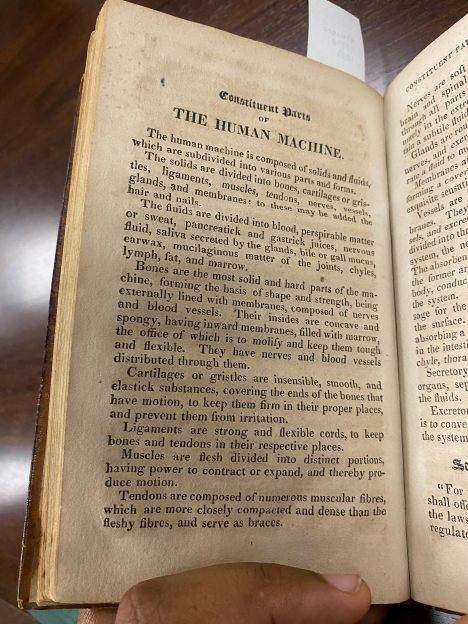
The American Physician, 1824
Published in 1824, The American Physician emerged in a period before pediatrics existed as a recognized medical field. During this time, medical knowledge was fragmented and often blended with moral, religious, and folk traditions. Families, especially mothers, were viewed as the primary caretakers and moral authorities responsible for children’s physical and spiritual well-being. The book itself reflects a society where health advice circulated through domestic manuals rather than medical professionals, emphasizing that a “healthy home” was both a moral and physical environment.
The American Physician is an early American medical handbook that offers a very deep look into how health, morality, and domestic responsibility connect with each other before pediatrics and modern public health systems existed. This document reflects a period when illness was seen as both a physical and moral condition, for instance, something caused not only by “bad air” or “impure diet” but also by improper living or maternal negligence. Within the text, mothers are portrayed as the moral and medical caretakers of the home, responsible for safeguarding both the body and the soul of the child. This framing connects back to the 19th-century ideology of the “moral mother,” positioning women as central figures in sustaining the family’s virtue. Religion is also present in the book’s approach to health, emphasizing prayer and moral discipline as essential components of recovery. From a historical perspective on childhood, this document demonstrates how childhood health was not simply about survival but about upholding moral purity and social stability. It shows how early Americans viewed the “healthy child” as a reflection of divine order and family integrity, revealing that health itself functioned as a moral language long before it became a scientific one.
The Moralized Aspect of Medicine:
The text shows illness as more than a biological problem, but it also connects to a moral issue. Health failures were blamed on “bad air,” “impure diets,” or “improper maternal conduct,” reflecting the idea that sickness resulted from poor discipline or immoral behavior. Disease prevention thus became an ethical duty, not just a medical one.
Gender and the Duties of a Mother:
Mothers were also portrayed as the moral and medical guardians of the household. Their nurturing and self-sacrifice were directly tied to the health of their children. This then reinforced the 19th-century ideal of the “moral mother,” suggesting that a woman’s virtue was measured by her ability to raise healthy, obedient children.
Religious Influence on Medicine:
As for faith, it played an important role in healing practices. Prayer, moral correction, and religious devotion were considered essential to recovery, showing how medical guidance was deeply connected with spiritual belief. The home became a sacred space where bodily and moral cleanliness worked hand in hand.
Domestic Public Health:
The text reveals the roots of public health in the private realm. Families were expected to maintain cleanliness, discipline, and good moral order to protect not only their children but the broader community. In this way, the home served as the earliest model of preventative medicine.


“My Reflections,” 1942, and “‘Education for Victory’: The High School Victory Corps and Curricular Adaptation during World War II,” 1979
This document is an excerpt from an autobiography written by a male high school senior attending Worcester Central High School in 1942. At the time of the excerpt, this student was 17 years and 4 months old, and America had been fighting in World War I for a year. The student wrote about his aspirations for his future and how uncertain they were, given his impending draft to fight in the war once he turned 18 years old. At the time of writing this entry, it was unclear to America when the war would end. However, the student was certain that the end of the war would not be before he turned 18, meaning he would have to become a soldier once an adult. He himself stated that “[his] future did not look promising”. The student desired to pursue higher education and attend college to become a doctor. He planned to attend college for a few months after graduating from high school before enlisting in the U.S. Navy after turning 18 years old, the eligible age for the selective service. Despite his uncertain future, he still intended to pursue a college education in the U.S. Navy if deemed eligible for a new program that would allow him to study while in service.
This document illustrates the experience of older male children approaching the threshold of adulthood during a wartime America and the pressure of their education and future aspirations being uncertain or even potentially unattainable given their mandatory obligations to fight in the war. During World War 2, the growing need for soldiers led to a rising number of male youth enlisting as soldiers following high school graduation in addition to the emergence of high school programs to prepare the boys for military training and service, including the “High School Victory Corps” program for example. This excerpt shows the unique educational experience of older boys and the societal expectations placed on them for life after high school graduation, especially in comparison to girls who were prepared to enter domestic positions or replace overseas men in the workforce.
- Haggerty, Robert J. “My Reflections, Box 3 Folder 13”. Archives & Manuscripts, Edward G. Miner Library, University of Rochester Medical Center, Rochester, NY.
- Ugland, Richard M. “‘Education for Victory’: The High School Victory Corps and Curricular Adaptation during World War II.” History of Education Quarterly 19, no. 4 (1979): 435–51. https://doi.org/10.2307/368053.

Girls and Young Women on the Various Duties of Life , 1856
Girls and Young Women on the Various Duties of Life (1856) by Rev. George S. Weaver is a
mid-nineteenth-century conduct book intended to guide girls as they transitioned from childhood into womanhood. Published in New York by Fowler and Wells, it reflects a period in which American society increasingly linked moral virtue, domestic responsibility, and femininity to the social order. This document serves as a prescriptive text rather than a descriptive account – it tells us less about what girls actually did and more about what adults believed they should become. From a historical perspective, it offers valuable insight into how childhood and adolescence were gendered moral projects. Weaver frames the development of young girls as a moral, intellectual, and physical formation process, emphasizing piety, modesty, and discipline as key steps in “worthy womanhood.” In doing so, the book illuminates how adults in the mid-Victorian era sought to regulate female childhood through moral instruction and social expectations.
From the perspective of childhood history, Weaver’s text represents a history of childhood – it captures adult constructions of youth and the societal values imposed on girls as they matured. As historians such as Philippe Ariès and Hugh Cunningham note, the nineteenth century saw the rise of childhood as a distinct, sentimentalized stage of life shaped by education, moral reform, and gender ideology. Weaver’s work fits squarely within that framework: it codifies how girlhood was treated as preparation for moral adulthood rather than an independent life stage. For historians, this document is valuable because it reveals the language and moral codes through which girlhood was disciplined and idealized. It raises questions about how moral authority, gender, and education intersect in shaping female identity – and how young women were taught to internalize societal norms even before reaching adulthood. As such, it provides a key lens into how nineteenth-century Americans imagined the transition from innocent childhood to “useful” womanhood.
- Weaver, G. S. Girls and Young Women on the Various Duties of Life. New York: Fowler and
Wells, Publishers, 1856. Retrieved from the Rochester Medical Archives. - Cunningham, Hugh. The Invention of Childhood. London: BBC Books, 2006. Available via Internet Archive. https://archive.org/details/inventionofchild0000cunn
- Ariès, Philippe. Centuries of Childhood: A Social History of Family Life. Translated by Robert Baldick. New York: Alfred A. Knopf, 1962. Originally published in French as L’Enfant et la Vie Familiale sous l’Ancien Régime (Paris: Plon, 1960). https://www.representingchildhood.pitt.edu/pdf/aries.pdf


